Loggers
A logger reads gateways on a schedule, with no page open. It keeps every telegram and every value it reads, and it delivers them as files by email, by FTP or by SFTP. It starts again by itself when the bench restarts.
A user or an administrator has the Loggers tab. A contractor does not.
Who has a logger
An administrator makes a logger, and then gives it to users and to building managers: Actions, then Change, on its row, then Users, and a tick for each person.
A user who was given a logger sees it, changes it, starts and stops it, and reads what it kept. A user cannot change:
- its name and its preset;
- its gateways, when an administrator wrote them. When the administrator left the gateways empty, the user writes them.
Only an administrator deletes a logger: Change in the row's Actions menu, then Delete.
A building manager
A building manager sees only the loggers an administrator gave them, and has only the Loggers tab. Their rows have no buttons. Press a row to open one window, which shows:
- the gateways of the logger, and whether each one is heard;
- the last 5 readouts and the last 5 deliveries;
- the meters, which the building manager may change;
- the delivery, which the building manager may change.
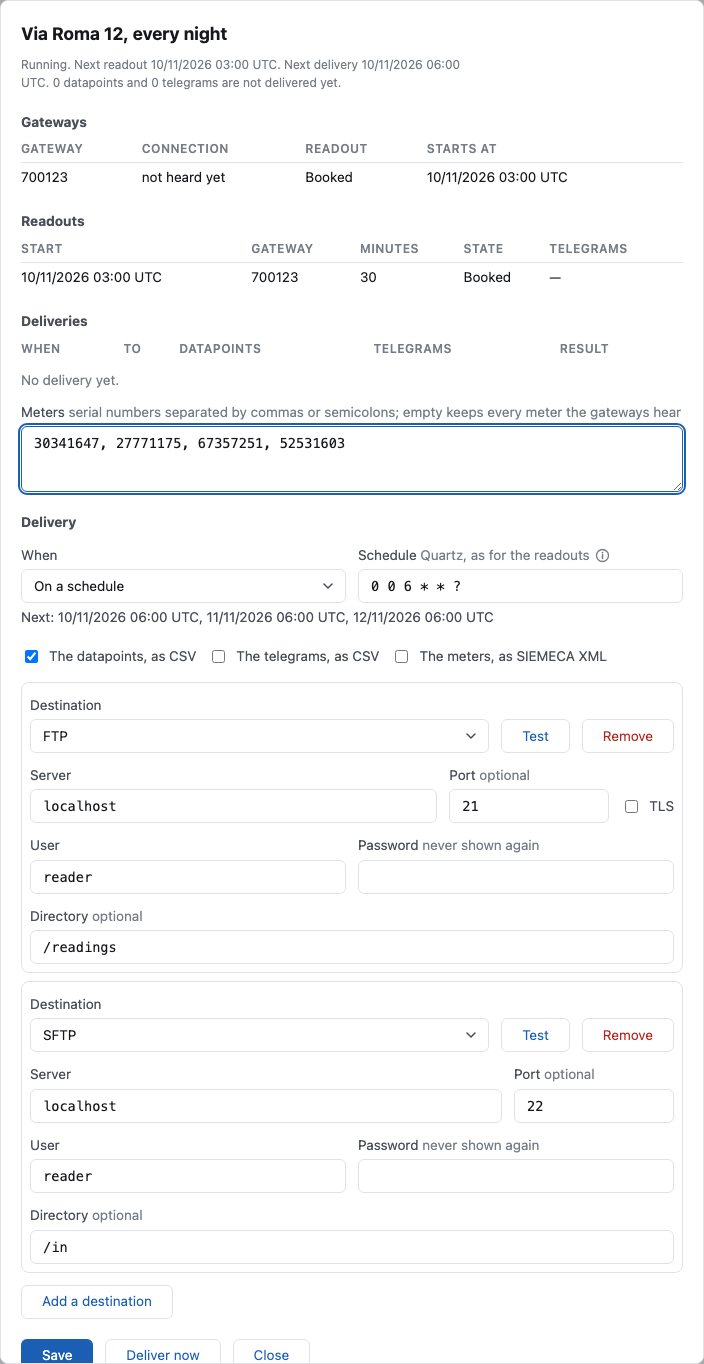
Save keeps the meters and the delivery. Everything else stays as the administrator wrote it. Deliver now sends at once what was not delivered yet, with the delivery as it is saved: press Save first after changing it. It shows only when a delivery is saved. A building manager cannot start or stop a logger, download its files, or open a session.
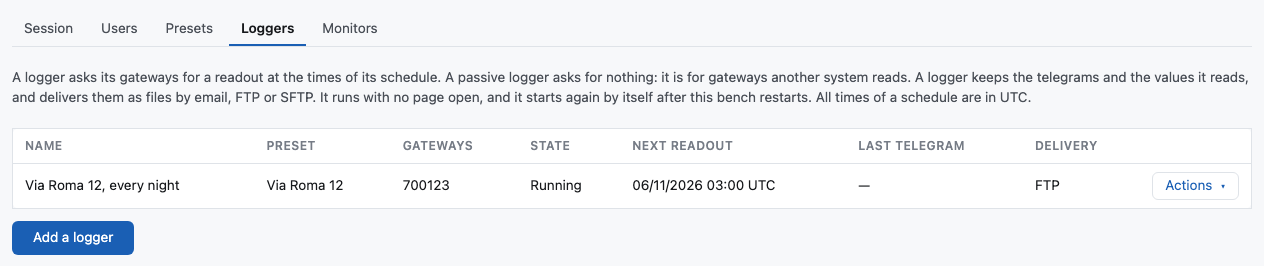
What a logger holds
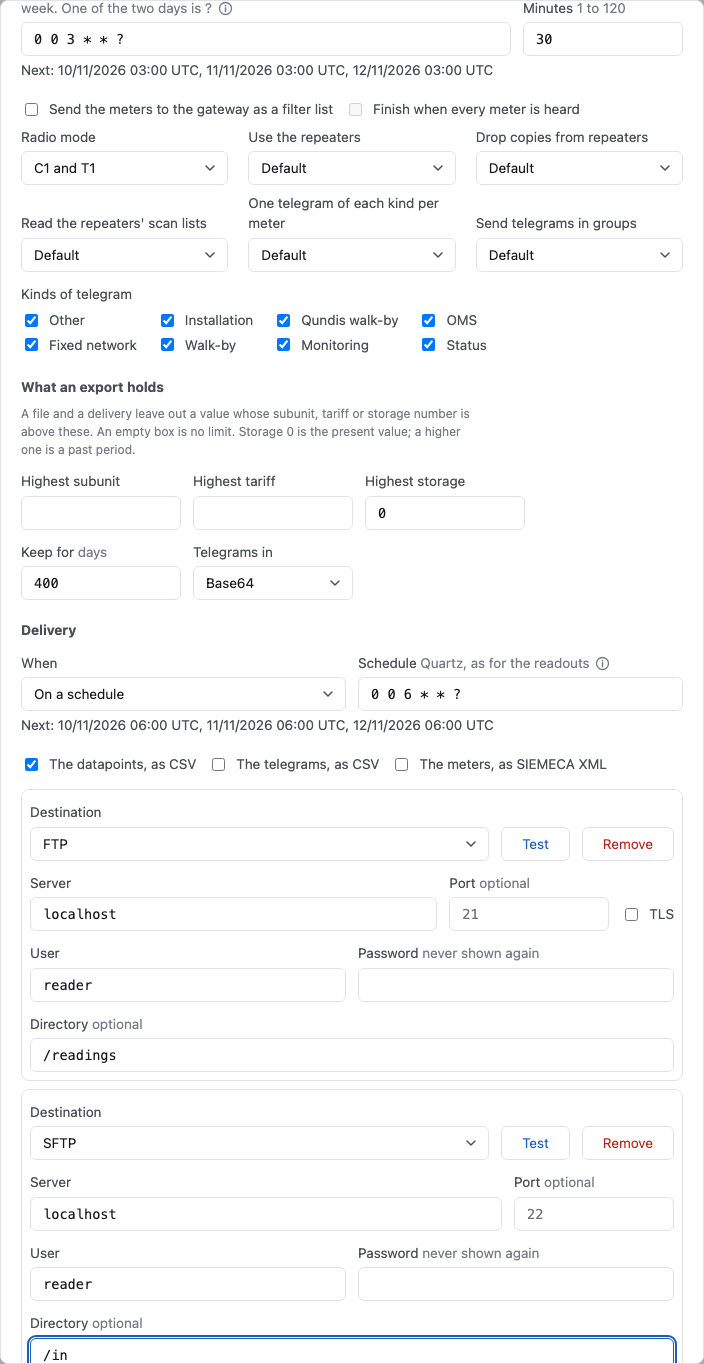
Add a logger opens a window with the fields.
- Preset
- The broker, its password and the AES keys.
- Gateways
- One or more gateway ids. A logger with none does not start, unless it is passive: a passive logger with none keeps every gateway of the broker.
- Meters
- Optional. With a list, the logger keeps only these meters. With none, it keeps every meter the gateways hear, the neighbours' too.
- Passive
- The logger sends nothing to the gateways. See below.
- Schedule
- When a readout starts, as a Quartz cron in UTC: second, minute, hour, day of the month, month, day of the week. One of the two days is
?.0 0 3 * * ?is every day at 03:00,0 0 3 L * ?the last day of each month,0 0 3 LW * ?its last working day,0 0 3 L-3 * ?three days before the last, and0 0 3 ? * FRI#1the first Friday. A day of the week is a name or a number from 1, Sunday, to 7. This is not the cron of a gateway's own schedule. The whole syntax is in How a schedule is written. - Minutes
- How long a readout runs, 1 to 120.
- Options
- The filter list and every option of the Readout panel of a session, in its words: the radio mode, the repeaters, copies from repeaters, the repeaters' scan lists, one telegram of each kind, telegrams in groups, and the kinds of telegram.
- Highest subunit, tariff, storage
- What a file holds. A value above one of these is left out. An empty box is no limit. Storage 0 is the present value.
- Keep for
- How many days the logger keeps what it read.
- Delivery
- When it is sent: On a schedule, a Quartz cron too, or After each readout. What is sent: the datapoints, the telegrams, the meters as SIEMECA XML, the meters as a
.repfile, or more than one. And its destinations: up to five, each an email, an FTP server or an SFTP server.
The page shows the next three times under each schedule.
The (i) after the name of each schedule shows a short reference of the Quartz syntax, with examples. Move the pointer over it, or click it to keep it open. Escape closes it and leaves the window open. The whole syntax, with more examples, is in How a schedule is written.
When the preset names gateways or meters, the window writes them into Gateways and Meters for you. Choose another preset and they change with it. What you typed yourself stays.
How the readouts run
A gateway sleeps most of the time, and it keeps one readout for later. So the logger asks each gateway for the next readout only, with its start time. The bench sends the request again each time the gateway connects, until the readout starts. When a readout ends, the logger asks for the next one.
Two things follow:
- One logger reads a gateway. A second logger on the same gateway would replace the readout of the first, so the bench refuses to start it.
- A readout you ask for by hand in the logger's session replaces the one the logger asked for. The logger asks again when yours ends.
Stop stops a readout that runs now. A readout the gateway already holds for later still runs once, and nothing is kept from it.
A passive logger
Tick Passive for gateways that another system reads. A passive logger sends nothing to a gateway: no readout, no stop, no schedule. It keeps what the gateways send when that other system reads them.
A passive logger may name no gateway. It then keeps what every gateway under the preset's topic prefix sends. On a broker with many gateways that is a lot of telegrams: give it a list of meters, or a short Keep for, when you do not need all of them.
A passive logger shares a gateway with anything. Its session refuses every button that would send something.
What is kept
- Every telegram, as it arrived, with the time and the gateway.
- Datapoints: one value of one meter. A meter sends the same value many times in a readout, so a datapoint is kept when the value changed, or when the last one kept is an hour old.
A telegram that cannot be read, because the preset has no key for it, is kept as a telegram and gives no datapoint.
Changing a logger
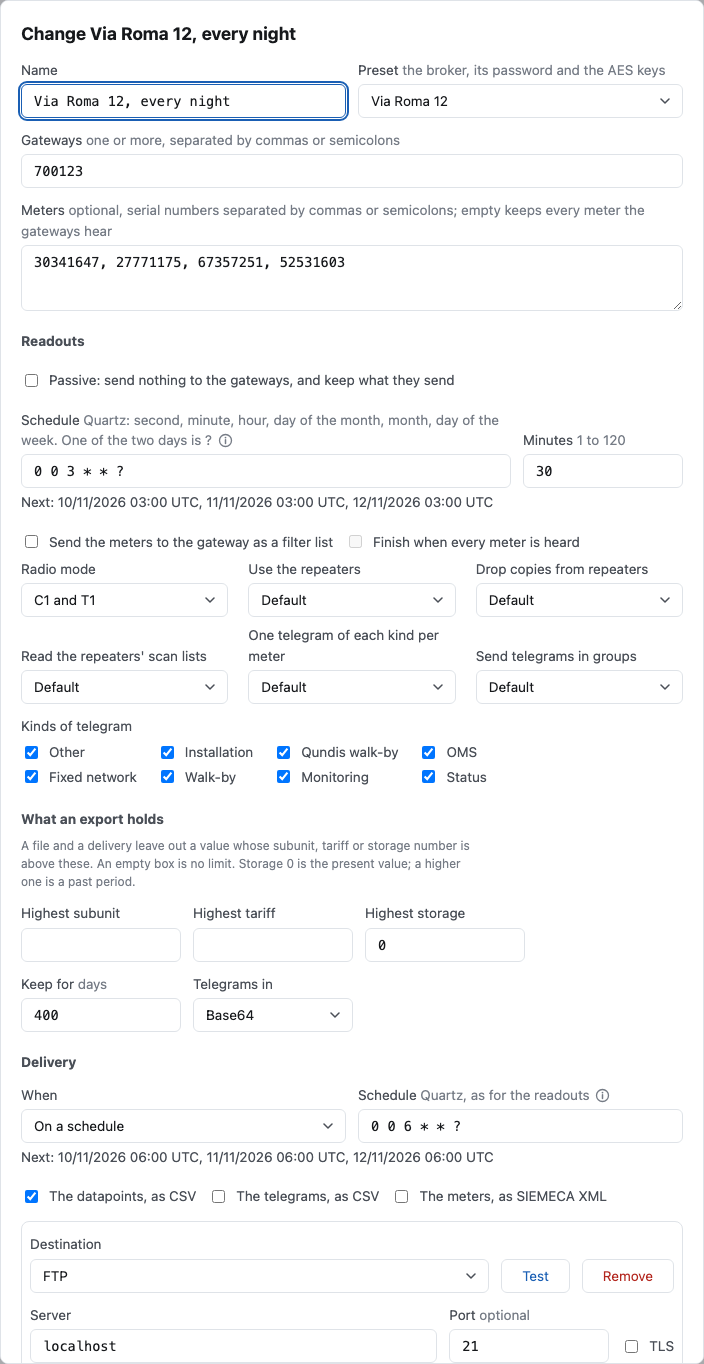
Change opens the same window, with what the logger has in each field. Save the logger keeps what you changed.
An administrator also has Delete there. Every telegram and every datapoint the logger kept is deleted with it, and the bench asks before it does so.
Cloning a logger
Clone, in the row's Actions menu, opens the window of a new logger with everything of that logger but three things: the name is empty, and the gateways and the meters are the preset's, or empty where the preset names none. The destinations are copied with their passwords and their keys. Write a name and press Add the logger. The new logger is stopped, and nobody is given it yet. Only an administrator clones a logger.
The password of a destination is shown as dots, and the browser does not offer to save it: it is the password of a server, not yours.
Details
Press a logger's row to see its details: the gateways, the last 5 readouts and the last 5 deliveries.
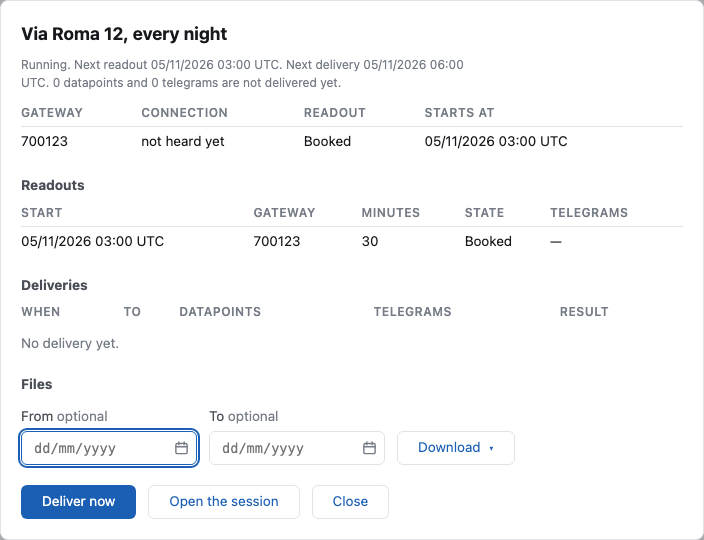
- Booked
- Asked for; the gateway has not started it yet.
- Running
- The gateway reports that it runs.
- Finished
- The gateway reports the end, and how many telegrams it sent.
- Not started
- The gateway did not report a start within five minutes of the time. It did not connect before the time, or it refused.
- Not known
- The bench was not running at the time, or the gateway never reported the end.
Download is a menu with four files of the period between the two dates:
Datapoints, Telegrams, Meters as SIEMECA XML, and Table of
meters as a .rep file. The dates are days in UTC, and both are in
the period. With no dates the file holds everything the logger keeps. A
period with too many rows is refused; choose a shorter one.
The datapoints file is CSV with these columns: read_at, gateway,
identity, manufacturer, version, medium, quantity, function,
storage, tariff, subunit, value, unit, measured_at. The telegrams
file is the Frames file of a session, which the M-Bus Explorer reads.
The meters as SIEMECA XML
SIEMECA XML is the file that Qundis's own software writes for a readout. The logger writes version 1.1, for programs that already read these files.
- One file for each delivery, named
<logger>_00000000_0000_<yyyyMMddHHmmss>.xml. The time is the first telegram of the file, in UTC. - The preset is the group and the logger is the location.
- Each gateway is a
communicator, with its firmware, when it was last heard, and its battery. - Each meter is a
measuredev, with the values of its newest telegram in the file. With a list of meters, only those are written, in the order of the list. A listed meter that was not heard is not in the file. - A meter that was heard and could not be read, because the preset has no
key for it, has its header and no value, and
errorflags8.
The values are written as Qundis writes them: a decimal comma, dates as
dd.mm.yy, x x x for a value the meter does not have, and --.--.-- for
a date it does not have. The limits of subunit, tariff and storage do not
apply to this file: Qundis writes every value of a telegram.
One difference from Qundis's own files is known. For the Qundis heat and water meters that send only the walk-by telegram, Qundis's software also writes the twelve older month ends and the error date. The bench does not decode those yet, so its file has the present value, the set day and the last month end of these meters.
The meters as a .rep file
A .rep file is the table that the radio network software of Qundis and
Honeywell writes: one row for each meter. The logger writes it as Qundis's
description of the format says, for programs that already read these files.
- One file for each delivery, named
<yyyy-MM-dd_HHhmm>.<logger>.rep. The time is when the file was written, in Italian time. - The first two lines name the gateway that heard most of the meters, the time, and the number of meters. Then two empty lines, then the table.
- Each meter is a row with the values of its newest telegram in the file: the present value, the set day and its date, and up to 18 month ends, newest first. With a list of meters, only those are written, in the order of the list, as in the SIEMECA file.
- A meter that was heard and could not be read has a row with its number,
maker, version, medium and status, and
x x xfor every value. - A set day or a month end that the meter sends with no date is written as
x x x: a value with no date cannot be used.
The columns are separated by a tab, and the lines end with CR LF. Numbers
have a decimal comma, dates are dd.mm.yy, and energy is in kWh. The
limits of subunit, tariff and storage do not apply to this file.
Deliveries
A logger delivers to up to five destinations. A destination is one email, one FTP server or one SFTP server. Add a destination adds one, and Remove takes it away. With no destination, the logger delivers nothing. When it delivers, and what files, are the same for every destination.
Each destination receives what it has not received yet. When one fails, nothing is lost: the next delivery sends it the same rows, and the other destinations do not receive them twice. One that fails does not stop the others. A destination added later receives what the logger reads from then on, not what it kept before. Deliver now sends to every destination without waiting for the schedule.
Test, beside Remove, tries one destination at once, with its fields
as they are, saved or not. An email destination receives a short email; an
FTP or SFTP server receives a file test.txt. The answer is under the
destination, in red when it failed. A test stores nothing: for an SFTP
server reached for the first time, it says the server's key, and the key is
remembered at the first real delivery.
After each readout sends when the readouts of one round have ended. A round is the readouts of every gateway of the logger with the same start time. The delivery waits for the last gateway, and is sent at most ten seconds after that gateway reports its end. A gateway that says nothing does not hold the delivery for ever: five minutes after its readout's time, the readout is Not known or Not started, and the delivery is sent with what came. When a delivery of a round fails, what it held goes with the next round. A passive logger asks for no readout, so it delivers on a schedule.
- Email: one to five addresses, which all receive the same mail. The files are attached.
- FTP: a server on a public address, a user, a password and an optional directory. Tick TLS for FTP over TLS. The password is kept by the bench and never shown again.
- SFTP: the same fields, with no TLS, because SFTP is always encrypted. The port may be any port, and an empty Port is 22. Only a password signs in. The bench remembers the key of the server at the first delivery, and the window shows it as Key of the server. Compare it with the key the owner of the server gives you. When the server later shows another key, the delivery fails and nothing is sent. If the server was replaced, tick Forget this key and save: the next delivery takes the new key.
When there is nothing new, nothing is sent, and the list says Nothing new. A large amount goes as several deliveries, one after the other.
The session of a logger
A running logger holds a session. Every administrator finds it in the Sessions list, marked with the logger's name, and opens it like any session: the gateway cards, the meters, the log. Open the session in the details does the same.
This session has no Disconnect. It ends when the logger is stopped.
How a schedule is written
A logger has two schedules: one for the readouts and one for the deliveries. Both are written in the same way, as a Quartz cron: one line of six fields, with a space between them. Each field names the values of one part of a time. The schedule names every time that agrees with all the fields.
0 0 3 * * ?
| | | | | +-- day of the week
| | | | +---- month
| | | +------ day of the month
| | +-------- hour
| +---------- minute
+------------ second
This one is every day at 03:00:00.
Every time is in UTC. Central European time is 1 hour ahead of UTC in
winter and 2 hours ahead in summer. So 0 0 3 * * ? is 04:00 in Italy in
winter and 05:00 in summer.
The page shows the next three times under the box while you type. Read them before you save: they are the fastest way to see what a schedule means.
The fields
| Field | Values | Signs it takes | |
|---|---|---|---|
| 1 | Second | 0 to 59 | * , - / |
| 2 | Minute | 0 to 59 | * , - / |
| 3 | Hour | 0 to 23 | * , - / |
| 4 | Day of the month | 1 to 31 | * , - / ? L W |
| 5 | Month | 1 to 12, or a name | * , - / |
| 6 | Day of the week | 1 to 7, or a name | * , - / ? L # |
| 7 | Year | the year itself, as 2027 | * , - / |
The year is optional. Most schedules have six fields and no year.
The names of the months are JAN, FEB, MAR, APR, MAY, JUN, JUL,
AUG, SEP, OCT, NOV and DEC.
A day of the week is counted from Sunday, and Sunday is 1.
| 1 | 2 | 3 | 4 | 5 | 6 | 7 |
|---|---|---|---|---|---|---|
SUN |
MON |
TUE |
WED |
THU |
FRI |
SAT |
A name is safer than a number, because other cron dialects count the days in
another way. Names and the letters L and W are read in capital or small
letters.
The signs of every field
| Sign | Meaning | Example |
|---|---|---|
* |
Every value. | * as the month: every month. |
, |
A list. | 6,18 as the hour: 06 and 18. |
- |
A range. Both ends are in it. | MON-FRI: Monday to Friday. |
/ |
Steps: a start, then every so many values. | 5/15 as the minute: 5, 20, 35 and 50. |
A list holds ranges and steps too: 0 0 6,12-14 * * ? is 06:00, 12:00, 13:00
and 14:00.
A range may pass the end of the field. As the hour, 22-2 is 22, 23, 0, 1
and 2. FRI-MON is Friday, Saturday, Sunday and Monday. NOV-FEB is November
to February.
Steps. The number before / is the start, and the number after it is the
step.
0/15as the minute is 0, 15, 30 and 45.*/15and/15mean the same.8-18/2as the hour is every second hour from 08 to 18: 8, 10, 12, 14, 16 and 18.- The count starts again in each hour, day, month or year. So
0/5as the hour is 0, 5, 10, 15 and 20, and then 0 again: the last gap is 4 hours, not 1/10as the day of the month is the 1st, the 11th, the 21st and the 31st, and then the 1st of the next month.
The two day fields and ?
A schedule has two fields that name a day: the day of the month and the day
of the week. You write one of them, and ? in the other. ? means: this
field names no day.
0 0 3 15 * ?names a day of the month: the 15th.0 0 3 ? * MONnames a day of the week: every Monday.0 0 3 * * ?and0 0 3 ? * *mean the same: every day.
A schedule with ? in both fields is refused. A schedule with ? in none is
refused too, also when both are *. This is the mistake that people make most
often.
Signs of the day of the month: L and W
| Sign | Meaning |
|---|---|
L |
The last day of the month: the 31st, the 30th, or the 28th or 29th of February. |
L-3 |
Three days before the last day: the 28th in a month of 31 days. |
15W |
The working day nearest the 15th. A working day is Monday to Friday. |
LW |
The last working day of the month. |
W never leaves the month. When the 15th is a Saturday, 15W is Friday
the 14th. When it is a Sunday, 15W is Monday the 16th. But when the 1st is a
Saturday, 1W is Monday the 3rd, and not the Friday before, which is in the
month before.
W knows nothing of public holidays. A holiday from Monday to Friday is a
working day for it.
L may be in a list: 0 0 3 15,L * ? is the 15th and the last day of each
month.
W may be in a list too: 0 0 3 10W,20W,LW * ? is the working day nearest
the 10th, the one nearest the 20th, and the last working day of each month.
The bench reads each day of the list by itself, so a day that moves to the
Friday before does not take the others with it.
A day that a month does not have is not moved to another day.
0 0 3 31 * ? names only the seven months that have 31 days. 0 0 3 29 2 ?
names only the leap years. For the end of each month, write L.
Signs of the day of the week: # and L
| Sign | Meaning |
|---|---|
FRI#1 |
The first Friday of the month. 6#1 is the same. |
MON#3 |
The third Monday of the month. |
FRI#5 |
The fifth Friday. A month with four Fridays has no time. |
FRIL |
The last Friday of the month. 6L is the same. |
L |
With no day before it: Saturday, the last day of the week. |
A schedule holds one # only. MON#1,FRI#1 is refused.
W and # go with one day, never with a range
The bench does not refuse 0 0 3 ? * MON-FRI#1 or 0 0 3 10-15W * ?. It
reads the range and leaves the sign out: the first is every day from
Monday to Friday, and the second is every day from the 10th to the 15th.
The three times under the box show it.
Examples
Every day:
| Schedule | When |
|---|---|
0 0 3 * * ? |
Every day at 03:00. |
0 30 6 * * ? |
Every day at 06:30. |
0 0 6,18 * * ? |
Every day at 06:00 and at 18:00. |
0 0 0/6 * * ? |
Every six hours: 00:00, 06:00, 12:00 and 18:00. |
0 0 * * * ? |
Every hour, at minute 0. |
0 15,45 * * * ? |
Every hour, at minute 15 and at minute 45. |
0 0 22-2 * * ? |
Every hour from 22:00 to 02:00. |
0 0/15 * * * ? |
Every 15 minutes. For a delivery only: see the limits. |
Days of the week:
| Schedule | When |
|---|---|
0 0 3 ? * MON |
Every Monday at 03:00. |
0 30 6 ? * MON-FRI |
Monday to Friday at 06:30. |
0 0 3 ? * SAT,SUN |
Saturday and Sunday at 03:00. |
0 0 3 ? * MON,WED,FRI |
Monday, Wednesday and Friday at 03:00. |
0 0 8-18/2 ? * MON-FRI |
Monday to Friday, every second hour from 08:00 to 18:00. |
0 0 6 ? * FRI#1 |
The first Friday of each month at 06:00. |
0 0 3 ? * MON#3 |
The third Monday of each month at 03:00. |
0 0 3 ? * FRIL |
The last Friday of each month at 03:00. |
Days of the month:
| Schedule | When |
|---|---|
0 0 3 1 * ? |
The first day of each month at 03:00. |
0 0 3 1,15 * ? |
The 1st and the 15th of each month at 03:00. |
0 0 3 1-7 * ? |
The first seven days of each month at 03:00. |
0 0 3 L * ? |
The last day of each month at 03:00. |
0 0 3 L-3 * ? |
Three days before the last day of each month at 03:00. |
0 0 3 LW * ? |
The last working day of each month at 03:00. |
0 0 3 1W * ? |
The first working day of each month at 03:00. |
0 0 3 15W * ? |
The working day nearest the 15th at 03:00. |
0 0 3 15,L * ? |
The 15th and the last day of each month at 03:00. |
Months and years:
| Schedule | When |
|---|---|
0 0 3 1 1/3 ? |
The first day of each quarter at 03:00: January, April, July and October. |
0 0 3 L 3,6,9,12 ? |
The last day of each quarter at 03:00. |
0 0 3 ? NOV-FEB MON |
Every Monday from November to February at 03:00. |
0 0 3 ? OCT-APR * |
Every day from October to April at 03:00. |
0 0 0 1 1 ? |
Once a year: 1 January at 00:00. |
0 0 3 1 1 ? 2027 |
Once: 1 January 2027 at 03:00. |
0 0 3 ? * TUE 2026-2027 |
Every Tuesday at 03:00, in 2026 and in 2027. |
The limits of this bench
Quartz reads more schedules than the bench takes. The bench adds these rules:
- A schedule is at most 63 characters.
- The readouts must not run into each other. The gap between two readouts
is at least Minutes plus 10 minutes. With 30 minutes, the times of the
schedule are at least 40 minutes apart. So
0 0 * * * ?, every hour, is accepted, and0 0/30 * * * ?, every half hour, is refused. - Two deliveries are at least 10 minutes apart.
0 0/15 * * * ?is accepted for a delivery, and0 0/5 * * * ?is refused. - A schedule names a time from now on.
0 0 3 30 2 ?, 30 February, names no time and is refused. A year in the past, as0 0 3 1 1 ? 2020, is refused too.
The bench checks the gap over the next 50 times of the schedule.
A readout starts at the second you write. A gateway that sleeps at that time starts late, or not at all: see How the readouts run.
Schedules that are refused
0 0 3 * * *- No
?. Write0 0 3 * * ?. 0 0 3 ? * ??in both day fields.0 0 3 1 * MON- Two days named. Write
?in one of the two. 0 3 * * ?- Five fields. The first field is the second: write
0 0 3 * * ?. 0 0 3 ? * 0- A day of the week is 1 to 7. Sunday is 1, or
SUN. 0 0 24 * * ?- An hour is 0 to 23. Midnight is 0.
0 0 3 32 * ?- A day of the month is 1 to 31.
0 0 3 ? * WED#6- A month has at most five Wednesdays.
0 0 3 ? * MON#1,FRI#1- Two
#in one schedule. 0 0 3 * * * *- This is the cron of a gateway's own schedule. See below.
This is not the cron of a gateway
A gateway has a schedule of its own, for its connections: see Changing a gateway's schedule. The gateway reads that one, and it is written in another way:
| A logger's schedule | A gateway's schedule | |
|---|---|---|
| Fields | Six, and the year when you want one. | Always seven, with the year. |
? |
In one of the two day fields. | Not used. |
| The two days | One is written. | Both are written, and both must match. |
| Sunday | 1 | 0 |
L, W, # |
Read. | Not read. |
A schedule copied from one box to the other is refused, or it names another day.